
We have a new paper out on arXiv! “Revealing Hund superdispersion with tunneling spectroscopy” https://arxiv.org/abs/2605.16580.
In collaboration with theoretical colleagues at the university of Cologne (Fabian Kugler), Flatiron Institute (Olivier Gringras and Antoine George), as well as experimental colleagues at the University of St Andrews (Carolina Marques,Phil King, Peter Wahl) and MPI Dresden (Edgar Morales).
Here we show experimental evidence for a new signature of Hunds coupling in the material Sr₂RuO₄. This was a massive joint effort requiring the combination of dynamical mean field theory expertise (Fabian, Olivier and Antoine) advanced experimental data and knowledge on the surface of Sr2RuO4 (Carolina, Edgar, Phil and Peter) and the ability to bring these different expertise together to extract new exciting physics, which is exactly what the RhodesLab does best.
What is the Hund’s interaction? In materials containing transition metal atoms, electrons can often occupy multiple orbitals simultaneously. The Hund’s interaction is a fundamental quantum mechanical rule that favours electrons in different orbitals aligning their spins. In strongly correlated materials, this interaction can dramatically reshape electronic behaviour, modifying quasiparticle properties, inducing strong correlation behaviour such as superconductivity without being close to a Mott insulating transition.
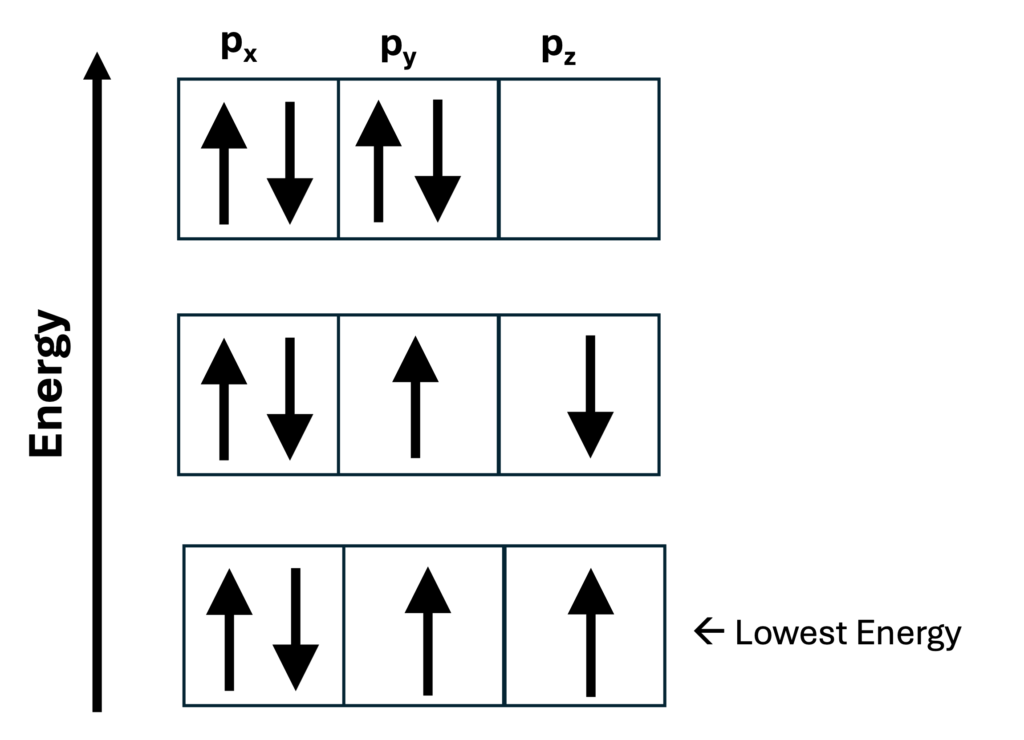
What is a superdispersion? When you bring many atoms together and allow electrons move between them (for example in a metal) The pathways that an electron can take are still influenced by the Hund interaction. We have found that this directly modifies the quasiparticle properties (specifically the real part of the self-energy varies non-monotonically with energy), producing an anomalous feature in the electronic structure called a superdispersion. This is directly visible in tunneling spectroscopy measurements, and our work provides the first clear experimental identification of this effect.

Check out full publication now on https://arxiv.org/abs/2605.16580.