
Theory of correlated quantum materials
The Hubbard model is one of the most important concepts for correlated quantum materials, a simple set of rules that helps us understand how electrons behave when they strongly interact with each other. Even though the model looks simple on paper, it can give rise to incredibly rich behaviour, including magnetism and superconductivity, and can describe a wide range of real quantum materials.

In our research, we explore how the single-particle electronic structure (t), a quantity that describes how electrons move within a system, can control the collective behaviour of electrons when in the presence of strong electron-electron interactions. For example to identify the conditions required to stabilise unconventional superconductivity.
We explore a wide range of phenomena associated with this model, from self energy interactions, influence of Hunds coupling and non-local interactions, importance of fermiology. As well as develop methods to map these parameters to material specific models that can be used to understand real materials.

Structural control of correlated phases
Utilising a combination of ab-initio methods and functional renormalisation group theory techniques, we aim to identify structural routes to manipulate and control the correlated ground state of real quantum materials.
We use a variety of computational methods to study correlated quantum materials, including density functional theory (VASP or Quantum Espresso) to get an approximation for the single-particle electronic structure, as well as understand how subtle structural details influence the electronic properties incorporating chemical bonding effects which are important to understand the electronic and superconducting properties of materials under pressure as well as surfaces and interfaces.

PRM,8,044801 (2024)
Theory of experimental measurements on correlated quantum materials
Experimental measurements are the best way to understand quantum materials. However, sometimes the data that is measured is obscured by complex processes and experimental artifacts. Understanding these artifacts allows us to extract deeper insight into correlated quantum materials and unlocks a closer, quantitative comparison between theory and experiment.
We closely interface with experimental methods in the study of correlated quantum materials, in particular, work on developing new methods to simulate and understand experimental measurements, in particular Angle-resolved photoemission spectroscopy and Scanning tunnelling microscopy, see, for example, the open-source software CalcQPI (https://scipost.org/SciPostPhysCodeb.61).

Latest News from The RhodesLab
- New Preprint! – Revealing Hund superdispersion with tunneling spectroscopy
 We have a new paper out on arXiv! “Revealing Hund superdispersion with tunneling spectroscopy” https://arxiv.org/abs/2605.16580. In collaboration with theoretical colleagues at the university of Cologne (Fabian Kugler), Flatiron Institute (Olivier Gringras and Antoine George), as well as experimental colleagues at the University of St Andrews (Carolina Marques,Phil King, Peter Wahl) and MPI Dresden (Edgar Morales). Continue reading “https://rhodes.wp.st-andrews.ac.uk/wp-content/themes/gridd”
 - Thomas Sheerin
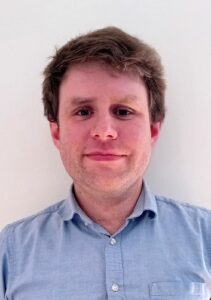 A big welcome to Dr Thomas Sheerin, who’s just started as a PDRA in the RhodesLab! Thomas will be working on understanding how material specific quasiparticle electronic structures can be used to explain and predict new forms of superconducting and magnetic phases. He brings expertise in non-fermi liquids from his PhD with Prof Chris Hooley.
 - Peter’s Poster Prize!
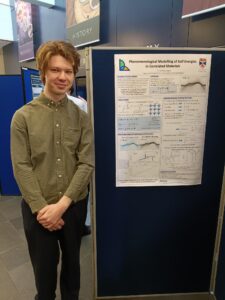 Huge congratulations to Peter Cudmore for winning the theoretical physics poster prize at the University of St Andrews! Peter is a Masters student in the RhodesLab, jointly supervised by Dr Carolina de Almeida Marques. Great recognition for some really exciting work on the phenomenological modelling of self-energies in Fermi liquids. Very well deserved.
 - We’re hiring!
 We’re very happy to share that the RhodesLab is hiring a postdoctoral researcher to join us in St Andrews. https://www.vacancies.st-andrews.ac.uk/Vacancies/W/6878/0/462146/889/research-fellow-ar3225 The postholder will play a central role in the RhodesLab, to research the mechanisms behind unconventional superconductors and other correlated electron states in real quantum materials, working across many-body theory, electronic structure simulation, and collaboration Continue reading “https://rhodes.wp.st-andrews.ac.uk/wp-content/themes/gridd”
Home | Research | Publications | The Group | Join Us
RhodesLab